
Evidence of the Frames in the Fire Truck Project
Fire Truck Project learning story found here
Let’s take a closer look at the Kindergarten Program Overall Expectations:
(BC − Belonging and Contributing SRWB − Self-Regulation and Well-Being DLMB − Demonstrating Literacy and Mathematics Behaviours PSI − Problem Solving and Innovating) (The Kindergarten Program Document)
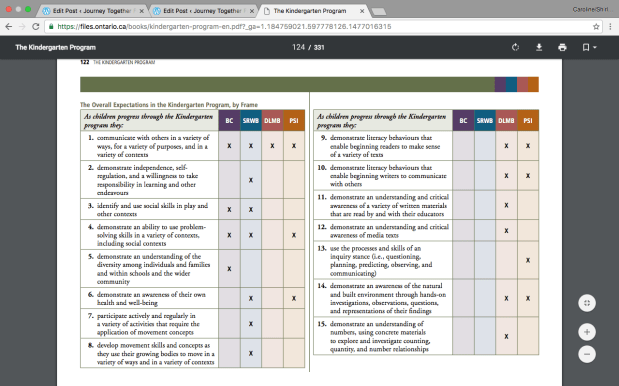

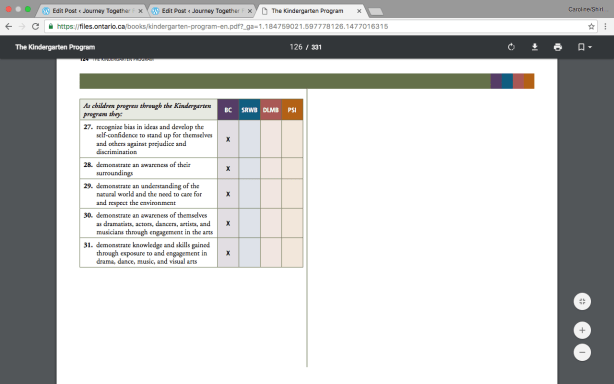
From just one play experience, we can gain a lot of information about what learning is taking place based on the four frames. While observing the children engaged in play and by documenting their learning, we are able to capture learning and share learning with parents and other educators. The documentation collected is used by educators to reflect and gain insight into the children’s learning. This will contribute to the educators’ assessment of this inquiry.
All four frames are all evident in our Fire Truck Project and identified using the following Kindergarten Program Overall Expectations(OE):
Belonging and Contributing:
OE 1. communicate with others in a variety of ways, for a variety of purposes, and in a variety of contexts
OE 3. identify and use social skills in play and other contexts
OE 4. demonstrate an ability to use problem-solving skills in a variety of contexts, including social contexts
OE 22. communicate their thoughts and feelings, and their theories and ideas, through various art forms
OE 26. develop an appreciation of the multiple perspectives encountered within groups, and of ways in which they themselves can contribute to groups and to group well-being
OE 30. demonstrate an awareness of themselves as dramatists, actors, dancers, artists, and musicians through engagement in the arts
OE 31. demonstrate knowledge and skills gained through exposure to and engagement in drama, dance, music, and visual arts
Self-Regulation and Well-Being
OE 1. communicate with others in a variety of ways, for a variety of purposes, and in a variety of contexts
OE 2. demonstrate independence, self-regulation, and a willingness to take responsibility in learning and other endeavours
OE 3. identify and use social skills in play and other contexts
OE 4. demonstrate an ability to use problem-solving skills in a variety of contexts, including social contexts
OE 8. develop movement skills and concepts as they use their growing bodies to move in a variety of ways and in a variety of contexts
OE 22. communicate their thoughts and feelings, and their theories and ideas, through various art forms
Demonstrating Literacy and Mathematics Behaviours
OE 1. communicate with others in a variety of ways, for a variety of purposes, and in a variety of contexts
OE 9. demonstrate literacy behaviours that enable beginning readers to make sense of a variety of texts
OE 10. demonstrate literacy behaviours that enable beginning writers to communicate with others
OE 14. demonstrate an awareness of the natural and built environment through hands-on investigations, observations, questions, and representations of their findings
OE 17. describe, sort, classify, build, and compare two-dimensional shapes and three-dimensional figures, and describe the location and movement of objects, through investigation
OE 19. collect, organize, display, and interpret data to solve problems and to communicate information, and explore the concept of probability in everyday contexts
OE 21. express their responses to a variety of forms of drama, dance, music, and visual arts from various cultures and communities
OE 22. communicate their thoughts and feelings, and their theories and ideas, through various art forms
Problem Solving and Innovating
OE 1. communicate with others in a variety of ways, for a variety of purposes, and in a variety of contexts
OE 4. demonstrate an ability to use problem-solving skills in a variety of contexts, including social contexts
OE 9. demonstrate literacy behaviours that enable beginning readers to make sense of a variety of texts
OE 10. demonstrate literacy behaviours that enable beginning writers to communicate with others
OE 13. use the processes and skills of an inquiry stance (i.e., questioning, planning, predicting, observing, and communicating)
OE 22. communicate their thoughts and feelings, and their theories and ideas, through various art forms
OE 24. use technological problem-solving skills, on their own and with others, in the process of creating and designing (i.e., questioning, planning, constructing, analysing, redesigning, and communicating)
Taking a closer look at the individual children, let’s look at the Kindergarten Program Specific Expectations (SE). Here are just a few of the pictures taken that represent some of the specific expectations met during this inquiry.
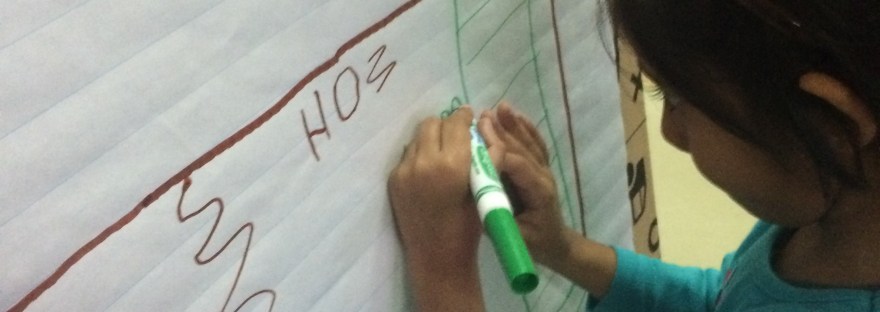
During a large group discussion, Little H contributes an idea to the fire truck plan. Her peers work with her to sound the word “hose” out.
SE 1.2. listen and respond to others, both verbally and non-verbally

|
Little A uses familiar letters and sounds to spell the word “wheel.” SE 9.1. use reading behaviours to make sense of familiar and unfamiliar texts in print |

|
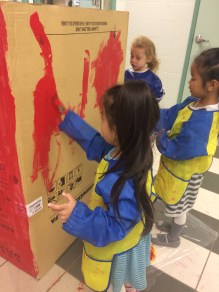
As the students collaboratively paint the fire truck box, they discuss prior knowledge and experiences with community helpers. SE 25.3. express their thoughts |
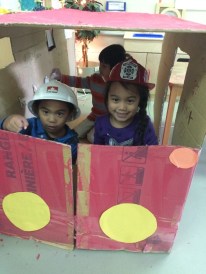
| As the children take on the role of firefighters, conversation can be over heard as they retell Robert Munsch’s “The Fire Station.”
SE 23.4. communicate their understanding of something (e.g., a familiar story, an experience, a song, a play) by representing their ideas and feelings through the arts |
This blog created by,




 Journey Together FDK
Exceptional, love the connections to the four frames-overall expectations, compounded with our catholic graduate expectations, definitely a best practice to be shared. Bravo team😃😃👏🏻
Hi there,
Thanks for following up on my suggestion to link evidence of learning to the four frames of the Kindergarten program document. It was meant to show all those who follow your blog how such a rich learning experience such as the fire truck inquiry uncovers learning in so many areas and provides rich evidence of assessment as and for learning. As you have stated, so many of the overall expectations are evident in such an inquiry. If educators think carefully together on how to document this learning, then there wiil be much evidence to draw from that will inform planning (why this learning for this child at this time in this way) and the new communication of learning templates. Awesome job ladies! All the best!
Dolores
Thank you Patti! We are blessed to have such supportive Administration at our school, you and Tom bring out the best in both educators and students.
Thank you Dolores for pushing our learning further, and for prompting us to use our blog to help others. We truly appreciate your continued support!
Reblogged this on Journey Together Full Day Kindergarten.