Documentation is a fantastic way to share learning and acts as a window for parents, staff and the school community. Full Day Kindergarten still holds many questions for lots of people; Are the children just playing? How is my child learning? How will children in the Full Day Kindergarten Program be ready for grade 1? These questions are just a few. Many parents just embarking with their child in phase 3 have very little understanding of what is happening in the classroom when parental involvement is limited. Newsletters are a wonderful tool to help answer some of those questions. First step you need to make before moving forward with a newsletter is to get your camera ready, and get those Image Releas forms signed!! Here is an example of our very first newsletter created Sept 2010, phase one of our journey into Full Day Kindergarten. September 2010 “The Fire Truck
As the children and staff embark on the new adventure of the Full Day Kindergarten Program, we decided to capture and document how the concept of learning through play extends and uses the interest of the children to further learning and promote early learning concepts. After carefully observing and interacting with the children in this program, an interest in fire fighters, fire trucks and fire safety emerged. This interest was demonstrated by the children through conversation, dramatic play and independent and group literacy experiences. Educators began furthering this interest by adding more books related to fire trucks, and fire fighters to the shelves and asking questions such as, “What do fire fighters do for our community?”, “What color is a fire truck?”, “What do they use to put out the fire?”


During indoor and outdoor play, children and staff began role playing the various roles associated with fire fighters, as they wore fire hats and attempted to put out the fires around them. To continue this growth and interest, children and staff together created our very own Fire Truck! We discussed colors we would use in order to make our fire truck, how many wheels we would need to give it, how many windows and doors etc. to ensure we had the best fire truck for our little fire fighters! After each child carefully signed their name to our fire truck, to ensure we take extra special care of it, we began to enjoy what we created and play!


Reflecting on Our Learning
Before this learning experience ended, we invited the children to share their own thoughts about our Fire Truck Inquiry. Their voices remind us that meaningful learning is best understood through the eyes of the children themselves.
What was your favourite part of building and playing in the fire truck?
“Writing our names in it.”
“Playing in it.”
“The funnest thing was playing.”
“The funnest part was painting it and going inside.”
“Being in the box… the windows and the doors.”
“Building it was fun!”
“Firefighters have tools to put out fires… hoses… somebody sprayed me with the water.”
“I liked playing.”
“I like to build fire trucks.”
“I liked painting it red.”
We can’t wait to discover where our next inquiry will lead us!
What Should a Learning Newsletter Include?
A newsletter like this should capture the learning journey rather than simply report classroom events. Consider including:
- Photographs that showcase children engaged in authentic play and learning
- Children’s quotes and conversations recorded throughout the inquiry
- Documentation of observations, discoveries, materials, and resources that supported the learning
- Reflections that connect children’s experiences to their developing understanding
Please note: The original classroom photographs from this newsletter (September 2010) have been removed, as image release permissions at that time did not include online sharing.
Unlike traditional monthly newsletters, these documentation newsletters are created when an inquiry has reached a meaningful point of reflection. Rather than following a calendar, they celebrate the depth of children’s thinking, learning, and collaboration throughout a particular investigation.
Creating a Classroom Learning Newsletter
Over the years, many educators have asked if there is a special template used to create newsletters like these.
The answer is no—there is no template! In fact, they’re surprisingly simple to create.
Many years ago, my friend and colleague Amanda Flude, whom I worked with at The Copper House, showed me just how easy the process could be.
Getting Started
- Open a new Microsoft Word document.
- Begin writing the story you want to share with families, always keeping your audience in mind.
- Whenever you want to add a photograph, select Insert → Pictures.
- Choose the images that best represent the children’s learning.
- Right-click each image and select Wrap Text (or Picture Format, depending on your version of Word).
- I typically use Tight or Behind Text to allow the pictures to flow naturally with the written documentation.
That’s it!
One Piece of Advice…
One lesson I learned after several years of creating these newsletters was to keep a simple checklist of the children who have appeared in each publication.
With 25–30 children in a classroom, it’s easy to unintentionally feature some children more often than others. Families naturally enjoy seeing their child represented as an active learner, so a checklist helps ensure every child is celebrated over the course of the year.
Most importantly, have fun with it. These newsletters are an opportunity to be creative while making children’s thinking and learning visible for families.
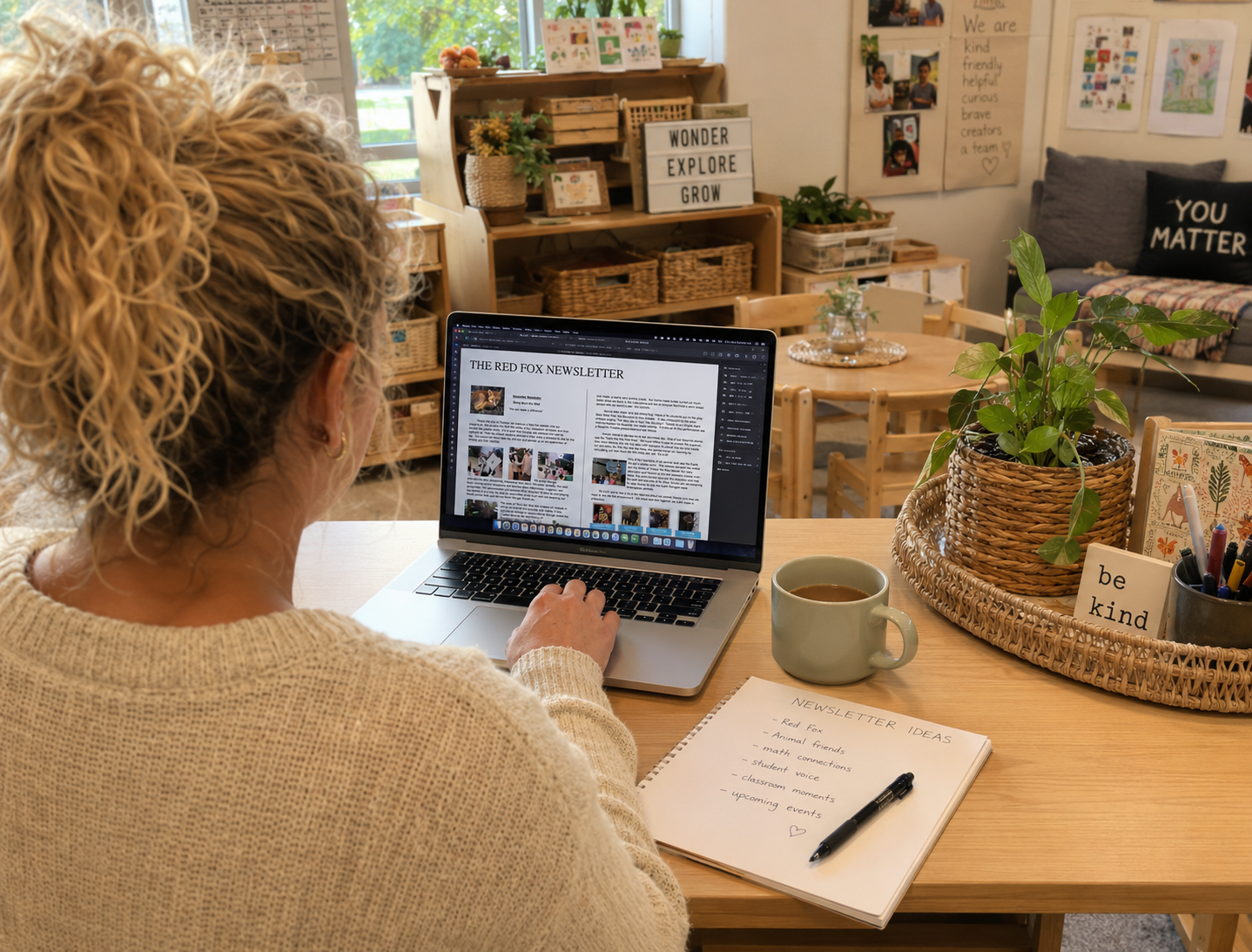
THE RED FOX NEWSLETTER

Bring Back the Wild
“We Can Make a Difference”
Toward the end of October, an unexpected visitor wandered into our playground—a beautiful Red Fox. From the safety of our classroom windows, and later through our outdoor doors, we watched in amazement as he quietly explored our schoolyard. For several minutes, we observed him while he seemed equally curious about us. Eventually, he slipped beneath a portable through a small opening to rest for the day.
This memorable encounter sparked a classroom-wide inquiry into Canadian wildlife, animal habitats, and our role in caring for the natural world.
Together, we explored a variety of informational texts, discovering fascinating facts about Canadian animals while learning about habitats, hibernation, migration, and camouflage. We also enjoyed many fictional stories featuring animal characters, inspiring meaningful conversations, questions, and dramatic play.
Our Full-Day Kindergarten classroom quickly transformed into places where children could deepen their understanding through play. At the Dramatic Play Centre, children became veterinarians caring for woodland animals, recreated bird families nesting in their habitats, and eagerly shared newly discovered animal facts with one another—just like our Earth Rangers!
One story, The Little Red Hen, inspired children to retell familiar stories using puppets and masks while also sparking an unexpected interest in baking. Through making bread together, the children discovered the importance of carefully following a recipe. They quickly learned that adding “just a little more” flour—and even a bucket of water from the classroom washroom—might seem like a great idea, but certainly doesn’t produce delicious bread! Fortunately, our co-op student, Rochelle, was an avid baker who helped us make wonderful homemade bread. We also churned our own butter, this time carefully following the recipe, and proudly enjoyed warm bread topped with our homemade butter. It was a delicious learning experience!
Inspired by their growing love of storytelling, many of the children enthusiastically performed Bear Goes Over the Mountain, introduced through the classic song The Bear Went Over the Mountain. With the support of our Grade 8 reading buddies, the children created masks and props for their performance. Their interest naturally extended into a Reader’s Theatre presentation exploring different types of bird homes.
Animal literature also became an important part of our mathematics learning. One of our favourite stories was My Sister Ate One Hare, which inspired rich mathematical thinking as we investigated the question:
“How many animals did the sister eat?”
The children enjoyed the story so much that they created their own version, Mr. Poli Ate One Tarantula, and eagerly calculated just how much Mr. Poli could possibly eat. (The answer? Quite a lot!)
One of the highlights of our inquiry was a visit from the Earth Rangers. The children were captivated by the live animal presentation, especially the snake, Timber the Pine Marten, and the owl that silently swooped just overhead. The experience inspired meaningful discussions about conservation and caring for wildlife. Motivated by what they had learned, the staff and students of St. Mary School joined together in fundraising efforts to help the Earth Rangers protect endangered animals.
Looking back, this inquiry reminded us that the most meaningful learning often begins with a single moment of curiosity. What started as a chance encounter with a Red Fox grew into weeks of rich literacy, mathematics, science, dramatic play, environmental stewardship, and collaborative learning.
Most importantly, the children came to understand that every small action matters—and that together, we really can make a difference.

For more info on the Earth Rangers please follow link: http://www.earthrangers.com/ (Some images shown of those children approved for this sharing through image release, professional fox photo found at; http://animals.nationalgeographic.com/animals/mammals/red-fox/)