Our inquiry into weather began with a windy day outdoors in our Full Day Kindergarten backyard. Windmills were placed in the garden for the children and provoked immediate curiosity and interest!
(PSI: SE 13.2-make predictions and observations before and during investigations)
Children began to watch the windmills daily, noticing the days they moved quickly and the days that they hardly moved. Educators prompted deeper thinking by asking, “Why do you think that might be?” The children came up with ideas and theories prior to conducting their own research:
Little Miss L: “They move fast when the sun is out!”
Little Miss A: “Umm…they move fast when I do this!” (makes a blowing motion)
Little Mr. D: “The windmills are moving fast today.”
Little Mr. G: “They are moving fast because the wind is blowing and when the wind is not out they don’t move.”
So we created a weather team that began to research, “Where does wind come from?” The children went to the Library and collected books about wind. They recorded their information and presented their findings during Sharing Time.
[DLMB: SE 11.10-retell information from non-fiction materials that have been read by and with the educator team in a variety of contexts (e.g., read-alouds, shared reading experiences), using pictures and/or props.]
During play, children were also given the opportunity to visit the Art Studio and choose various materials to show “What does wind look like?”
[BC: SE 30.2 – explore a variety of tools, materials, and processes of their own choice (e.g., blocks, puppets, flashlights, streamers, castanets, rhythm sticks, natural and recycled materials) to create drama, dance, music, and visual art forms in familiar and new ways]
As the children learned more about wind, they began to notice how the clouds moved on windy days. We lay out on the grass, watched the clouds and used our imagination to find animals and shapes in the clouds.
Our weather inquiry continued as we took a closer look at how clouds are formed and the various types of clouds. Informational texts were placed on the Inquiry Table so the children had the opportunity to research and create the types of clouds they observed each day.
[DMLB/PSI: SE 10.1- demonstrate an interest in writing (e.g., choose a variety of writing materials, such as adhesive notes, labels, envelopes, coloured paper, markers, crayons, pencils) and choose to write in a variety of contexts (e.g., draw or record ideas in learning areas)]
[All Four Frames: SE 22.1- communicate their ideas about something (e.g., a book, the meaning of a word, an event or an experience, a mathematical pattern, a motion or movement) through music, drama, dance, and/or the visual arts]
Check out our latest blog titled “The Weather Report” to see how the inquiry further developed and the children culminated their understandings. The Weather Report
Overall Expectations Represented
1.(All Four Frames)-communicate with others in a variety of ways, for a variety of purposes, and in a variety of contexts
2. (SRWB)-demonstrate independence, self-regulation, and a willingness to take responsibility in learning and other endeavours
3. (BC/SRWB)-identify and use social skills in play and other contexts
9. (DMLB/PSI)-demonstrate literacy behaviours that enable beginning readers to make sense of a variety of texts
10. (DMLB/PSI)-demonstrate literacy behaviours that enable beginning writers to communicate with others
11. (DMLB)-demonstrate an understanding and critical awareness of a variety of written materials that are read by and with their educators
13. (PSI)-use the processes and skills of an inquiry stance
14. (DMLB/PSI)-demonstrate an awareness of the natural and built environment through hands-on investigations, observations, questions, and representations of their findings
22. (All Four Frames)-communicate their thoughts and feelings, and their theories and ideas, through various art forms
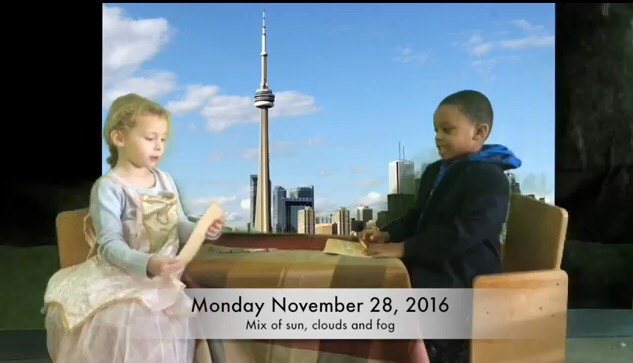
Since we began our inquiry into weather, each day a team of two or three children are chosen to take on the role of weather reporter. Take a moment to watch the video below to see one team in action!
This has been a big hit in our class! The children are so excited to report the weather to their classmates after each play time.
To learn about the daily weather, children are encouraged to use their senses while they play outdoors. Once they come inside, each reporter is asked to go to the classroom window and draw what they see and what they felt outside (Note: In the video, each child has a piece of paper in their hand with their own observations). After they record their observations, alongside an educator, they listen to CITY-DT’s Breakfast Television’s daily weather forecast. Children are encouraged to write the date and temperature for each day.
Let’s take a closer look for evidence of the overall expectations found in the four frames:
1.(All Four Frames)-communicate with others in a variety of ways, for a variety of purposes, and in a variety of contexts
2. (SRWB)-demonstrate independence, selfregulation, and a willingness to take responsibility in learning and other endeavours
3. (BC/SRWB)-identify and use social skills in play and other contexts
9. (DMLB/PSI)-demonstrate literacy behaviours that enable beginning readers to make sense of a variety of texts
10. (DMLB/PSI)-demonstrate literacy behaviours that enable beginning writers to communicate with others
13. (PSI)-use the processes and skills of an inquiry stance
15. (DMLS)-demonstrate an understanding of numbers, using concrete materials to explore and investigate counting, quantity, and number relationships
Specific Expectations Represented
Belonging and Contributing
1.2 listen and respond to others, both verbally and non-verbally (e.g., using the arts, using signs, using gestures and body language), for
a variety of purposes (e.g., to exchange ideas, express feelings, offer opinions) and in a variety of contexts (e.g., after read-alouds and shared reading or writing experiences; while solving a class math problem; in imaginary or exploratory play; in the learning areas; while engaged in games and outdoor play; while making scientific observations of plants and animals outdoors)
22.1 communicate their ideas about something (e.g., a book, the meaning of a word, an event or an experience, a mathematical pattern, a motion or movement) through music, drama, dance, and/or the visual arts
25.3 express their thoughts (e.g., about a science discovery, about something they have made) and share experiences
30.2 explore a variety of tools, materials, and processes of their own choice (e.g., blocks, puppets, flashlights, streamers, castanets, rhythm sticks, natural and recycled materials) to create drama, dance, music, and visual art forms in familiar and new ways
Self Regulation and Well Being
1.3 use and interpret gestures, tone of voice, and other non-verbal means to communicate and respond (e.g., respond to non-verbal cues from the educator; vary tone of voice when dramatizing; name feelings and recognize how someone else might be feeling)
1.6 use language (verbal and non-verbal communication) to communicate their thinking, to reflect, and to solve problems
2.2 demonstrate a willingness to try new experiences (e.g., experiment with new materials/tools; try out activities in a different learning area; select and persist with things that are challenging; experiment with writing) and to adapt to new situations (e.g., having visitors in the classroom, having a different educator occasionally, going on a field trip, riding the school bus)
2.3 demonstrate self-motivation, initiative, and confidence in their approach to learning
by selecting and completing learning tasks (e.g., choose learning tasks independently; try something new; persevere with tasks)
3.2 demonstrate the ability to take turns during activity and discussions (e.g., while engaged in play with others; in discussions with peers and adults)
Demonstrating Math and Literacy Behaviours
1.2 listen and respond to others, both verbally and non-verbally (e.g., using the arts, using signs, using gestures and body language),for a variety of purposes (e.g., to exchange ideas, express feelings, offer opinions) and in a variety of contexts (e.g., after read-alouds and shared reading or writing experiences; while solving a class math problem; in imaginary or exploratory play; in the learning areas; while engaged in games and outdoor play; while making scientific observations of plants and animals outdoors)
1.3 use and interpret gestures, tone of voice, and other non-verbal means to communicate and respond (e.g., respond to non-verbal cues from the educator; vary tone of voice when dramatizing; name feelings and recognize how someone else might be feeling)
1.5 use language (verbal and non-verbal communication) in various contexts to connect new experiences with what they already know (e.g., contribute ideas during shared or interactive writing; contribute to conversations in learning areas; respond to educator prompts)
10.1 demonstrate an interest in writing (e.g., choose a variety of writing materials, such
as adhesive notes, labels, envelopes, coloured paper, markers, crayons, pencils) and choose to write in a variety of contexts (e.g., draw or record ideas in learning areas)
10.2 demonstrate an awareness that text can convey ideas or messages (e.g., ask the educator to write out new words for them)
10.3 write simple messages (e.g., a grocery list on unlined paper, a greeting card made on a computer, labels for a block or sand construction), using a combination of pictures, symbols, knowledge of the correspondence between letters and sounds (phonics), and familiar words
10.5 experiment with a variety of simple writing forms for different purposes and in a variety of contexts
14.1 ask questions about and describe some natural occurrences, using their own observations and representations(e.g., drawings, writing)
15.7 explore and communicate the function/ purpose of numbers in a variety of contexts (e.g., use magnetic and sandpaper numerals to represent the number of objects in a set [to indicate quantity]; line up toys and manipulatives, and identify the first, second, and so on [to indicate ordinality]; use footsteps to discover the distance between the door and the sink [to measure]; identify a favourite sports player: “My favourite player is number twenty-four” [to label or name])
15.7 explore and communicate the function/ purpose of numbers in a variety of contexts (e.g., use magnetic and sandpaper numerals to represent the number of objects in a set [to indicate quantity]; line up toys and manipulatives, and identify the first, second, and so on [to indicate ordinality]; use footsteps to discover the distance between the door and the sink [to measure]; identify a favourite sports player: “My favourite player is number twenty-four” [to label or name])
20.2 use, read, and represent whole numbers
to 10 in a variety of meaningful contexts (e.g., use a hundreds chart to read whole numbers; use magnetic and sandpaper numerals to represent the number of objects in a set; put the house number on a house built in the blocks area; find and recognize numbers in the environment; write numerals on imaginary bills at the restaurant in the dramatic play area)
Problem Solving and Innovating
1.2 listen and respond to others, both verbally and non-verbally (e.g., using the arts, using signs, using gestures and body language),for a variety of purposes (e.g., to exchange ideas, express feelings, offer opinions) and in a variety of contexts (e.g., after read-alouds and shared reading or writing experiences; while solving a class math problem; in imaginary or exploratory play; in the learning areas; while engaged in games and outdoor play; while making scientific observations of plants and animals outdoors)
1.4 sustain interactions in different contexts (e.g., with materials, with other children, with adults)
1.5 use language (verbal and non-verbal communication) in various contexts to connect new experiences with what they already know (e.g., contribute ideas during shared or interactive writing; contribute to conversations in learning areas; respond to educator prompts)
1.6 use language (verbal and non-verbal communication) to communicate their thinking, to reflect, and to solve problems
1.7 use specialized vocabulary for a variety of purposes (e.g., terms for things they are building or equipment they are using)
1.8 ask questions for a variety of purposes (e.g., for direction, for assistance, to innovate on an idea, to obtain information, for clarification, for help in understanding something, out of curiosity about something, to make meaning of a new situation) and in different contexts (e.g., during discussions and conversations with peers and adults; before, during, and after read-aloud and shared reading experiences; while exploring the schoolyard or local park; in small groups, in learning areas)
1.10 retell experiences, events, and familiar stories in proper sequence (e.g., orally; in new and creative ways; using drama, visual arts, non- verbal communication, and representations; in a conversation)
9.1 use reading behaviours to make sense of familiar and unfamiliar texts in print (e.g., use pictures; use knowledge of oral language structures, of a few high-frequency words, and/or of sound-symbol relationships)
10.1 demonstrate an interest in writing (e.g., choose a variety of writing materials, such
as adhesive notes, labels, envelopes, coloured paper, markers, crayons, pencils) and choose to write in a variety of contexts (e.g., draw or record ideas in learning areas)
10.2 demonstrate an awareness that text can convey ideas or messages (e.g., ask the educator to write out new words for them)
10.3 write simple messages (e.g., a grocery list on unlined paper, a greeting card made on a computer, labels for a block or sand construction), using a combination of pictures, symbols, knowledge of the correspondence between letters and sounds (phonics), and familiar words
10.4 use classroom resources to support their writing (e.g., a classroom word wall that
is made up of children’s names, words from simple patterned texts, and words used repeatedly in shared or interactive writing experiences; signs or charts in the classroom; picture dictionaries; alphabet cards; books)
10.5 experiment with a variety of simple writing forms for different purposes and in a variety of contexts
13.4 communicate results and findings from individual and group investigations (e.g., explain and/or show how they made their structure; state simple conclusions from an experiment; record ideas using pictures, numbers, and labels)
20.2 use, read, and represent whole numbersto 10 in a variety of meaningful contexts (e.g., use a hundreds chart to read whole numbers; use magnetic and sandpaper numerals to represent the number of objects in a set; put the house number on a house built in the blocks area; find and recognize numbers in the environment; write numerals on imaginary bills at the restaurant in the dramatic play area)
23.4 communicate their understanding of something (e.g., a familiar story, an experience, a song, a play) by representing their ideas and feelings through the arts
24.3 make predictions and observations as part of the process of creating and designing
24.5 communicate and record results and findings either individually or in groups (e.g., explain and/or show how they made their structure; record ideas using pictures, words, numbers on labels, or in charts)


 [DLMB: SE 11.10- retell information from non-fiction materials that have been read by and with the educator team in a variety of contexts (e.g., read-alouds, shared reading experiences), using pictures and/or props.]
 [BC: SE 30.2 – explore a variety of tools, materials, and processes of their own choice (e.g., blocks, puppets, flashlights, streamers, castanets, rhythm sticks, natural and recycled materials) to create drama, dance, music, and visual art forms in familiar and new ways]

 [All Four Frames: SE 22.1- communicate their ideas about something (e.g., a book, the meaning of a word, an event or an experience, a mathematical pattern, a motion or movement) through music, drama, dance, and/or the visual arts]