

2016
The Kindergarten Program Document states:
Dr. Stuart Shanker, Canada’s leading expert on self-regulation, defines self-regulation as the ability to manage your own energy states, emotions, behaviours, and attention in ways that are socially acceptable and help achieve positive goals such as maintaining good relationships, learning, and maintaining well-being. Shanker draws on research to show how self-regulation lays the foundation for a child’s long-term physical, psychological, behavioural, and educational well-being. (p.154)
OUR INQUIRY INTO SELF REGULATION

Stuart Shanker
“Thanks for the invite to look at your work. I just loved the site and the photos are a must-see for everyone” (quote shared on our Twitter account: @FDKSandbox-Journey Together FDK)
In October 2011, we put in a proposal to do an inquiry on self-regulation. We had heard over and over again, the term Self-regulation whenever we went to workshops whether it was from Board personnel or Ministry personnel. We kept hearing about how self-regulation is important to a child’s early learning. The Ontario Full Day Learning Draft Document states, ”Self-regulation is central to a child’s capacity to learn,” and it has “…been shown to be best developed in play-based environments.” (p. 7) At the time we knew very little about self-regulation other than it had something to do with self-control and that it was somehow important to early learning. Along with our grade-level partners, Sandy Alves and Melissa Inches, we set out to dig deeper and what we found has enriched our program. We found that play was a primary conduit for self-regulation in young children and that changes to the classroom environment as well as participating in yoga and breathing exercises could positively impact self-regulatory behaviour.
Why Self-regulation
The ability to self-regulate is crucial because it directly effects how well a child will succeed in school and in later life. Those children who have good self-regulatory skills at 4 are healthier physically, mentally, and emotionally at 40. As adults, they have more stable, happier relationships, hold better paying jobs and are more satisfied with their work than those that demonstrated less self-regulatory skills as 4 year olds. People who have good self-regulation skills make healthier choices.
It is believed that up to 25% of students currently entering Grade One, do not have strong self-regulatory skills; however, the good news is that Self-regulation is a learned skill. This means that we as educators and parents, have the ability to change the trajectory of our students who need to develop self-regulation. We can give our students the tools to succeed in life.
What is Self-regulation?
Self-regulation is a complex topic. We are giving you a brief overview so that you can see how Self-regulation pertains to Full Day Kindergarten and success in school.
Dr. Stuart Shanker says, “Self-regulation can be defined as the ability to stay calmly focused and alert, which often involves- but cannot be reduced to – self-control.” (Shanker, S. Calm, Alert, and Learning)
Although self-regulation does have a component of self-control, that is not the only piece. Self-regulation is most importantly the ability to stay calm, focused and alert as we face stressors in our lives.
Dr. Shanker talks about 6 stages of arousal.
1. Asleep
2. Drowsy
3. Hypo-alert
4. Calmly focused and alert
5. Hyper-alert
6. Flooded
Calmly focused and alert is the optimal state for learning and interacting appropriately with others. The ability to self-regulate means that you are able to adjust your body and mind to attain and maintain the optimal state of arousal for a task or situation.
Our students need to be able to attain and maintain the appropriate state of arousal in order to successfully manage social interactions, deal with conflict appropriately and control emotions. In an instructional setting they have to be able to focus and shift attention; inhibit impulses; deal with frustration, delay gratification, deal with distractions and sequence their thoughts.
Unfortunately, children today have five times the amount of stress that children did in the 1930’s and are getting approximately two hours less sleep each night than children did a decade ago. So, not only are our young children facing more stress, but they are also getting less sleep, therefore, missing out on a chance to re-energize their bodies.
Stress creates negative emotions which deprive the body of energy so students who are under stress have less energy available to focus attention, inhibit their impulses, deal with distractions, and sequence their thoughts. Add this to the fact that focusing attention in itself takes a lot of energy. (Just think of how draining it is to listen to a lecture.) Then throw in the fact that some bodies are more sensitive to artificial lighting, noises and other distractions. Some of our children must work very hard to learn because they are not in that optimal “calmly focused and alert” state.
So, how can we help our students manage their stress and achieve a more calm, focused and alert state for learning? Through our Inquiry, we discovered that changes to the physical environment, Yoga and breathing techniques, lessons from The Mindful Child, as well as role-modelling conflict resolution and social conventions, helped to enhance the benefits of Play-based programming to keep our children more calm, focused and alert.
(This is the “Marshmallow Test” Shanker talks about in the video above)

Please take a moment to view this amazing video that truly highlights the importance of supporting the child and family!
Change the First Five Years and You Change Everything!
- The information shared within this blog has been collected and shared through what we have learned from our own classroom experiences. Networking is key! We can learn so much from other through dialogue and conversations. Thank you to all those we have learned from along the way!
Written by:


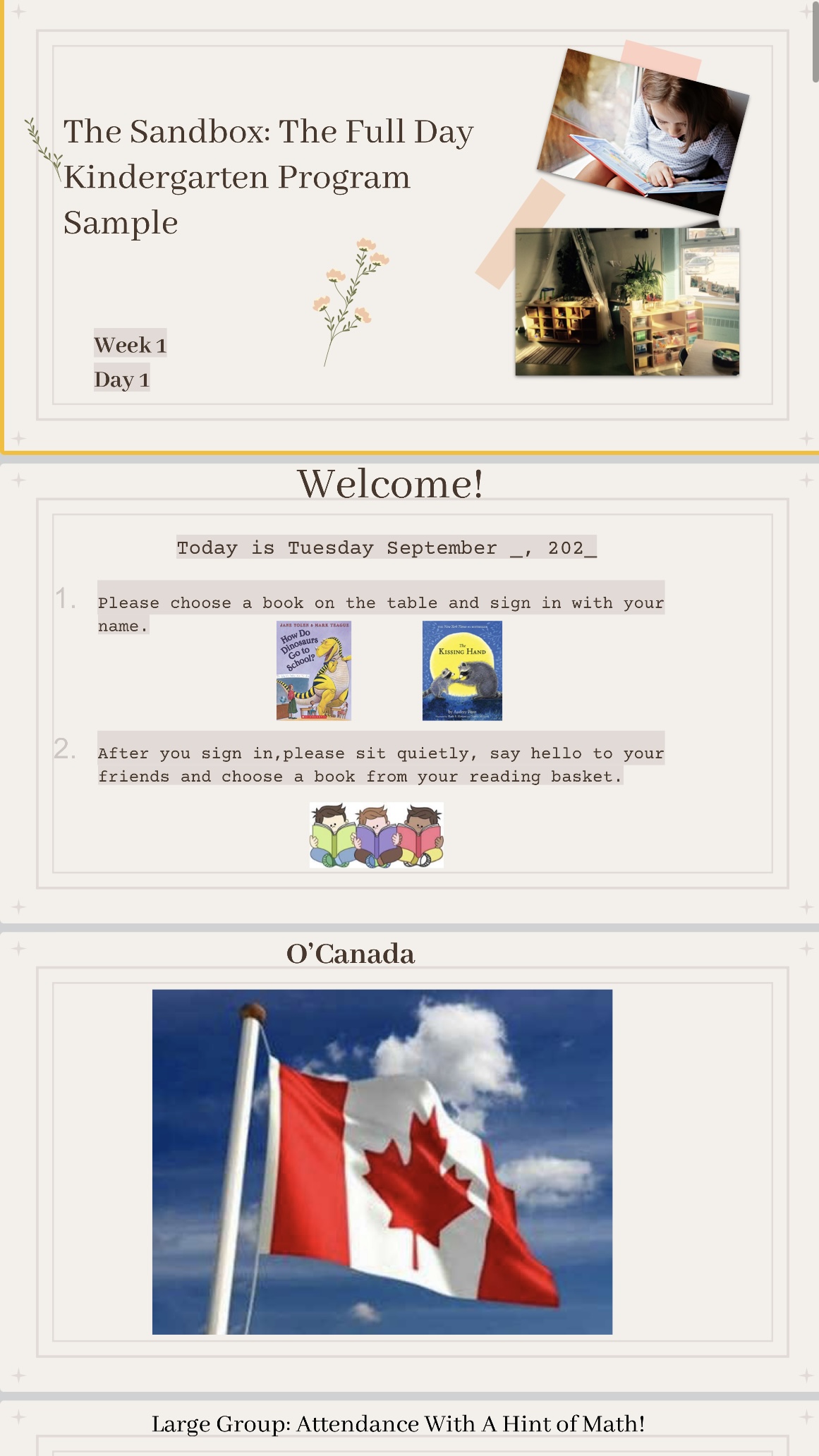
*If you are looking for resources that will help you set up and guide your first week of FDK, look no further! We got you!
The Sandbox: Curriculum Plan: Week 1 (Lesson Plan): https://www.teacherspayteachers.com/Product/Curriculum-Plan-Week-1-Lesson-Plan-8363368
The Sandbox: Weekly FDK Schedule (Sample): https://www.teacherspayteachers.com/Product/The-Sandbox-Weekly-FDK-Schedule-Sample-8363293
The Sandbox: Full Day Kindergarten Classroom Starter Bundle: https://www.teacherspayteachers.com/Product/The-Sandbox-Full-Day-Kindergarten-Classroom-Starter-Bundle-8356912
 Journey Together FDK