As I continue to work toward my Early Childhood Studies (BA) at Ryerson University (https://www.ryerson.ca/programs/undergraduate/early-childhood-studies/), I had an amazing opportunity to take two summer intensive courses on campus. I am currently in my last year, and up to this point all the courses taken have been achieved through distance education. This summer, I had a wonderful opportunity to meet some of my peers and professors.
Concept Development in Math, taught by the fabulous Lovisa Fung, was one of the intensive courses I had the privilege of taking. This particular course really allowed students to gain knowledge into how young children understand and engage in math. I decided to direct one of my main assignments required for this course into finding out how educators and parents can support and ease math anxiety in young children. I choose this topic because I experienced math anxiety as a child, still do today, and I wanted to make sure I did my best to support my own children, as well as the children I work with.
Below is a powerpoint that shares all my learning on this topic!
Today I had the honour of facilitating a professional development session entitled- Purposeful, Planned, Yet Flexible, Play at the Wee Wonder Conference held by DPCDSB and the CDRCP! #DPWee1dr19 Great day spent with so many dedicated early years educators!
An amazing feeling came over me last that night and I felt compelled to write and share;
Today Diane Kashin asked the Wee Wonder Conference group where their happy place was as a child?
At that moment I couldn’t answer as I was focused on prepping for my my upcoming presentation. Tonight I asked myself that question again, “Where was my childhood happy place? 💭
After just a few moments the answer was clear, the large tree in my back yard! I remember I used to climb, sometimes hide in the branches filled with green leaves. Try to climb as high as I could in hopes I would reach the very top. I knew I was capable of reaching the highest, strongest branch. It was risky, but I knew my limits and I was familiar with this particular tree.
I would think to myself “Is this what the birds see?”
There were moments I would stay perfectly still as small birds would fly in and out of the tree. I can hear my mom calling my name, and sense my brother was playing below near by.
Thank you Diane for that memory, and for the that brief moment I was in tune with myself as a child.
Please read and share!!! As the future of Full Day Kindergarten is in question Kerry McCuaig, a Fellow in Early Childhood Policy, Atkinson Centre, Ontario Institute for Studies in Education, University of Toronto, brings to light all the evidence based research supporting FDK.
As new educator teams prepare to embrace a brand new year in Full Day Kindergarten, various questions and uncertainties may come to mind;
Will my new teaching partner and I work well together?
What will the first day look like?
How do I plan for purposeful learning?
What will the flow of the day look like?
Let’s face it….everyone’s day will look and feel different. Some boards/classrooms practice a slow entry start to the week. While some welcome the Year 2 students in for the first two days, followed by small groups of Year 1 children who enter each following day, with all children in by the end of the week, others may all start at once. Personally, if your Administration and Board will support the slow entry, I do suggest this format as it allows educators and children to bond in smaller numbers, easing the transition for children and parents.
Begin your day by welcoming children and parents in. Expect a few tears, but if you are comfortable allow parents to help by staying for a few minutes. Let your Year 2 students lead the way. Prep them and let them know they are your leaders, and that you all need to work together to help out new friends. I have never come across a child who didn’t take this role very seriously and rise to the occasion.
Set up a table just outside the cloakroom with a sign in sheet. Make sure all the students names are present and available, but do not place too much pressure….your leaders will do most of the demonstrating while your new friends watch and observe this part of the routine.
Play soft quiet calming music (we used our smart board, and rotated photos of children at play), and provide books on the carpet to encourage a space to gather together. Some new friends will be very curious and interested in exploring the classroom, thats ok! They have plenty of time to adjust to the rules and routines of the day. Eventually, do your best to have all the children, even for 2-5 minutes at the gathering space to share introductions.
After this point, every classroom is different depending on planning times, outdoor times, library times and gym times. Keep in mind when planning your day to day routines that each play/inquiry period should be one hour in length twice a day. Pulling groups is not ideal at this time, so take a look at your schedule and see if you can find ways to utilize other times of the day.
Let’s begin with one key suggestion to help you get stared;
Work as a team! This is the key to a successful Full Day Kindergarten Program. We have been put together, teacher and ECE, for a reason. Both professions when brought together can produce something absolutely amazing! Trust in that. Will you always see eye to eye, no. Will conflict arise, maybe. Be patient, be kind, be respectful, be understanding, be thoughtful…go slow…and most importantly laugh together. Let’s face it the 26 + little people you are both working with are smart, super cute and most of the time… hilarious! To help you understand this partnership even further I will share a quote offered to my teaching partner Shirley and I from Charles Pascal ;
“Founded on mutual respect for the equal and complementary gifts that each of you brings to the sandbox, you are creating something bigger than the the sum of these gifts for the sake of the kids. Your understanding of genuine play-based, curiosity driven pedagogy is also critical to the future success of the children. Your leadership is inspiring.”
(This quote inspired the name chosen for the curriculum portion of the blog, The Sandbox)
This program is NOT meant to be prescribed, and should always follow the lead of the child when planning for learning in the classroom.
Ideally, children in FDK have free choice to learn and play where they choose within the playroom and outdoor learning space.
Educators must take the time during play to move throughout each learning area. Take the time to interact, listen, observe, ask questions (when appropriate), scaffold and extend learning.
Know your learners and provide various entry points for all to engage.
Remember, play and inquiry should be the primary approach for gathering group and individual assessments.
Keys to a successful playroom:
Expect noise! However, when the children are presented a learning environment that is stimulating and engaging, the noise will sound more like a busy hum. However, when the noise gets too loud, the children seem to be disengaged and the play has no purpose (e.g., running around, throwing toys, etc.), take a good look at the classroom. Evaluate what learning spaces are not working, where the children are not playing and change up the environment! Add something new and follow their lead!
Plan ahead! If one educator is invested and involved in a valuable learning opportunity, the other educator circulates and helps children to problem solve, find and discover materials they may be asking for that will enhance their play/learning.
Attempt to gain as much assessment as possible during play and inquiry experiences, however realistically some children may need to be pulled aside to gain further insight into their current understanding. If you find you need to pull children aside, keep it short! Also, call on these children before they become involved and invested in their play/learning.
Less is more!!!! Some children may need to learn how to use the materials found in the classroom. Take the time to teach the children what and how toys and manipulative can be purposefully used. While children are exploring new materials, start with just a few pieces, add more while children are using them, and tidy up appropriately.
Share resources with other FDK classrooms. Ask your administration if there are any storage areas within your school to store resources and materials not being used. Educators can then go to this space each week to gather new materials to add to or change up centres.
Note: No themes. Remember classrooms are interest led. Plan for all learners.
One more word of advice, balance conversations with parents/caregivers. While some children will bounce into your classroom as if they were always there, an need little support to successfully move through the day, others may need a little more support. Every child is different! When communicating with families of those who may need a little more of a helping hand, please balance out positive and negative messages to parents. Make sure parents hear of the little successes as well as some of the struggles. Build a positive and healthy relationship with the whole family, this will create a team approach the child WILL notice and respond positively to.
This blog has both theory based information and practical advice in all areas of FDK! Here are some quick links to various areas of interest;
The information shared within this blog has been collected and shared through what we have learned from our own experiences. Networking is key! We can learn so much from other through dialogue and conversations. Thank you to all those we have learned from along the way!
Advertisement
Interested in provoking student interest and new learning? Check out Bits Kits!
What did you hear last week? What did you notice? Here are some ideas to extend and provoke new learning!
Evaluate your classroom and program, are the children still enjoying what was set out last week? Where are the children engaged and learning? What learning areas are not being visited? You do not have to change the entire room, only change what is not working! If it is not broke…don’t fix it! 😉
We have recently begun an inquiry into using art media as a thinking tool. We have always valued the ‘Hundred Languages’ approach of the Reggio philosophy but we want to more clearly focus on how we use art as a language for the students to communicate ideas, emotions, questions, and learning.
We are hoping to see them digging deeper and extending their own learning as they use art media to represent their thinking.
One of our resources is a book by Ann Pelo – The Language of Art: Inquiry-based Studio Practices in Early Childhood Settings. It’s providing us with a great start. We began by exploring texture, movement and colour in many ways.
Here are two of our young boys totally immersed in the sensory activity of finger painting, of exploring the feel of the paint on the paper, the mixing of colours, and the excitement of lines created and then wiped away. As the boys discovered the secondary and tertiary colours being created by mixing paints it was evident that they were not only learning about colour, they were relaxed and engaged and enjoying a positive encounter with an artistic medium. We are hoping that positive experiences such as this one will encourage the students to choose art as a means to communicate their learning.
This is some of the dialogue captured:
Little Mr. J squealed with delight as he began to mix the blue and yellow paint together.
“What colour will my paper be now?”
” Look!!! It’s making green! Yellow and blue make green!”
Little Mr. C responded: “What makes green, J?”
“Yellow and blue!”
Little Mr. C was incredulous – “Yellow and blue??”
As they were conversing Little Mr. J was adding a few more colours- “Now it’s making brown!”
Little Mr. C: “What is?”
Little Mr. J: All these colours together make brown!!
Little Mr. C was busy mixing blue and yellow together and jumping with excitement.
“Green!! Blue and yellow make green. I’m going to put in more colours!’
Little Mr. J slid his hands rhythmically over the paper, swaying side to side. ” My hands go skating when I’m asleep. They skate like this.”
Skating hands
I asked him what happy hands might look like on the paper. Both boys broke into big grins and started jumping their fingers up and down and up and down.
” Happy hands!” they laughed “Happy hands!”
Our inquiry into weather began with a windy day outdoors in our Full Day Kindergarten backyard. Windmills were placed in the garden for the children and provoked immediate curiosity and interest!
(PSI: SE 13.2-make predictions and observations before and during investigations)
Children began to watch the windmills daily, noticing the days they moved quickly and the days that they hardly moved. Educators prompted deeper thinking by asking, “Why do you think that might be?” The children came up with ideas and theories prior to conducting their own research:
Little Miss L: “They move fast when the sun is out!”
Little Miss A: “Umm…they move fast when I do this!” (makes a blowing motion)
Little Mr. D: “The windmills are moving fast today.”
Little Mr. G: “They are moving fast because the wind is blowing and when the wind is not out they don’t move.”
So we created a weather team that began to research, “Where does wind come from?” The children went to the Library and collected books about wind. They recorded their information and presented their findings during Sharing Time.
[DLMB: SE 11.10-retell information from non-fiction materials that have been read by and with the educator team in a variety of contexts (e.g., read-alouds, shared reading experiences), using pictures and/or props.]
During play, children were also given the opportunity to visit the Art Studio and choose various materials to show “What does wind look like?”
[BC: SE 30.2 – explore a variety of tools, materials, and processes of their own choice (e.g., blocks, puppets, flashlights, streamers, castanets, rhythm sticks, natural and recycled materials) to create drama, dance, music, and visual art forms in familiar and new ways]
As the children learned more about wind, they began to notice how the clouds moved on windy days. We lay out on the grass, watched the clouds and used our imagination to find animals and shapes in the clouds.
Our weather inquiry continued as we took a closer look at how clouds are formed and the various types of clouds. Informational texts were placed on the Inquiry Table so the children had the opportunity to research and create the types of clouds they observed each day.
[DMLB/PSI: SE 10.1- demonstrate an interest in writing (e.g., choose a variety of writing materials, such as adhesive notes, labels, envelopes, coloured paper, markers, crayons, pencils) and choose to write in a variety of contexts (e.g., draw or record ideas in learning areas)]
[All Four Frames: SE 22.1- communicate their ideas about something (e.g., a book, the meaning of a word, an event or an experience, a mathematical pattern, a motion or movement) through music, drama, dance, and/or the visual arts]
Check out our latest blog titled “The Weather Report” to see how the inquiry further developed and the children culminated their understandings. The Weather Report
Overall Expectations Represented
1.(All Four Frames)-communicate with others in a variety of ways, for a variety of purposes, and in a variety of contexts
2. (SRWB)-demonstrate independence, self-regulation, and a willingness to take responsibility in learning and other endeavours
3. (BC/SRWB)-identify and use social skills in play and other contexts
9. (DMLB/PSI)-demonstrate literacy behaviours that enable beginning readers to make sense of a variety of texts
10. (DMLB/PSI)-demonstrate literacy behaviours that enable beginning writers to communicate with others
11. (DMLB)-demonstrate an understanding and critical awareness of a variety of written materials that are read by and with their educators
13. (PSI)-use the processes and skills of an inquiry stance
14. (DMLB/PSI)-demonstrate an awareness of the natural and built environment through hands-on investigations, observations, questions, and representations of their findings
22. (All Four Frames)-communicate their thoughts and feelings, and their theories and ideas, through various art forms
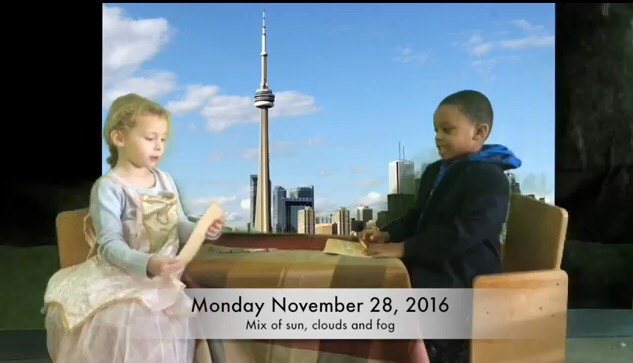
Since we began our inquiry into weather, each day a team of two or three children are chosen to take on the role of weather reporter. Take a moment to watch the video below to see one team in action!
This has been a big hit in our class! The children are so excited to report the weather to their classmates after each play time.
To learn about the daily weather, children are encouraged to use their senses while they play outdoors. Once they come inside, each reporter is asked to go to the classroom window and draw what they see and what they felt outside (Note: In the video, each child has a piece of paper in their hand with their own observations). After they record their observations, alongside an educator, they listen to CITY-DT’s Breakfast Television’s daily weather forecast. Children are encouraged to write the date and temperature for each day.
Let’s take a closer look for evidence of the overall expectations found in the four frames:
1.(All Four Frames)-communicate with others in a variety of ways, for a variety of purposes, and in a variety of contexts
2. (SRWB)-demonstrate independence, selfregulation, and a willingness to take responsibility in learning and other endeavours
3. (BC/SRWB)-identify and use social skills in play and other contexts
9. (DMLB/PSI)-demonstrate literacy behaviours that enable beginning readers to make sense of a variety of texts
10. (DMLB/PSI)-demonstrate literacy behaviours that enable beginning writers to communicate with others
13. (PSI)-use the processes and skills of an inquiry stance
15. (DMLS)-demonstrate an understanding of numbers, using concrete materials to explore and investigate counting, quantity, and number relationships
Specific Expectations Represented
Belonging and Contributing
1.2 listen and respond to others, both verbally and non-verbally (e.g., using the arts, using signs, using gestures and body language), for
a variety of purposes (e.g., to exchange ideas, express feelings, offer opinions) and in a variety of contexts (e.g., after read-alouds and shared reading or writing experiences; while solving a class math problem; in imaginary or exploratory play; in the learning areas; while engaged in games and outdoor play; while making scientific observations of plants and animals outdoors)
22.1 communicate their ideas about something (e.g., a book, the meaning of a word, an event or an experience, a mathematical pattern, a motion or movement) through music, drama, dance, and/or the visual arts
25.3 express their thoughts (e.g., about a science discovery, about something they have made) and share experiences
30.2 explore a variety of tools, materials, and processes of their own choice (e.g., blocks, puppets, flashlights, streamers, castanets, rhythm sticks, natural and recycled materials) to create drama, dance, music, and visual art forms in familiar and new ways
Self Regulation and Well Being
1.3 use and interpret gestures, tone of voice, and other non-verbal means to communicate and respond (e.g., respond to non-verbal cues from the educator; vary tone of voice when dramatizing; name feelings and recognize how someone else might be feeling)
1.6 use language (verbal and non-verbal communication) to communicate their thinking, to reflect, and to solve problems
2.2 demonstrate a willingness to try new experiences (e.g., experiment with new materials/tools; try out activities in a different learning area; select and persist with things that are challenging; experiment with writing) and to adapt to new situations (e.g., having visitors in the classroom, having a different educator occasionally, going on a field trip, riding the school bus)
2.3 demonstrate self-motivation, initiative, and confidence in their approach to learning
by selecting and completing learning tasks (e.g., choose learning tasks independently; try something new; persevere with tasks)
3.2 demonstrate the ability to take turns during activity and discussions (e.g., while engaged in play with others; in discussions with peers and adults)
Demonstrating Math and Literacy Behaviours
1.2 listen and respond to others, both verbally and non-verbally (e.g., using the arts, using signs, using gestures and body language),for a variety of purposes (e.g., to exchange ideas, express feelings, offer opinions) and in a variety of contexts (e.g., after read-alouds and shared reading or writing experiences; while solving a class math problem; in imaginary or exploratory play; in the learning areas; while engaged in games and outdoor play; while making scientific observations of plants and animals outdoors)
1.3 use and interpret gestures, tone of voice, and other non-verbal means to communicate and respond (e.g., respond to non-verbal cues from the educator; vary tone of voice when dramatizing; name feelings and recognize how someone else might be feeling)
1.5 use language (verbal and non-verbal communication) in various contexts to connect new experiences with what they already know (e.g., contribute ideas during shared or interactive writing; contribute to conversations in learning areas; respond to educator prompts)
10.1 demonstrate an interest in writing (e.g., choose a variety of writing materials, such
as adhesive notes, labels, envelopes, coloured paper, markers, crayons, pencils) and choose to write in a variety of contexts (e.g., draw or record ideas in learning areas)
10.2 demonstrate an awareness that text can convey ideas or messages (e.g., ask the educator to write out new words for them)
10.3 write simple messages (e.g., a grocery list on unlined paper, a greeting card made on a computer, labels for a block or sand construction), using a combination of pictures, symbols, knowledge of the correspondence between letters and sounds (phonics), and familiar words
10.5 experiment with a variety of simple writing forms for different purposes and in a variety of contexts
14.1 ask questions about and describe some natural occurrences, using their own observations and representations(e.g., drawings, writing)
15.7 explore and communicate the function/ purpose of numbers in a variety of contexts (e.g., use magnetic and sandpaper numerals to represent the number of objects in a set [to indicate quantity]; line up toys and manipulatives, and identify the first, second, and so on [to indicate ordinality]; use footsteps to discover the distance between the door and the sink [to measure]; identify a favourite sports player: “My favourite player is number twenty-four” [to label or name])
15.7 explore and communicate the function/ purpose of numbers in a variety of contexts (e.g., use magnetic and sandpaper numerals to represent the number of objects in a set [to indicate quantity]; line up toys and manipulatives, and identify the first, second, and so on [to indicate ordinality]; use footsteps to discover the distance between the door and the sink [to measure]; identify a favourite sports player: “My favourite player is number twenty-four” [to label or name])
20.2 use, read, and represent whole numbers
to 10 in a variety of meaningful contexts (e.g., use a hundreds chart to read whole numbers; use magnetic and sandpaper numerals to represent the number of objects in a set; put the house number on a house built in the blocks area; find and recognize numbers in the environment; write numerals on imaginary bills at the restaurant in the dramatic play area)
Problem Solving and Innovating
1.2 listen and respond to others, both verbally and non-verbally (e.g., using the arts, using signs, using gestures and body language),for a variety of purposes (e.g., to exchange ideas, express feelings, offer opinions) and in a variety of contexts (e.g., after read-alouds and shared reading or writing experiences; while solving a class math problem; in imaginary or exploratory play; in the learning areas; while engaged in games and outdoor play; while making scientific observations of plants and animals outdoors)
1.4 sustain interactions in different contexts (e.g., with materials, with other children, with adults)
1.5 use language (verbal and non-verbal communication) in various contexts to connect new experiences with what they already know (e.g., contribute ideas during shared or interactive writing; contribute to conversations in learning areas; respond to educator prompts)
1.6 use language (verbal and non-verbal communication) to communicate their thinking, to reflect, and to solve problems
1.7 use specialized vocabulary for a variety of purposes (e.g., terms for things they are building or equipment they are using)
1.8 ask questions for a variety of purposes (e.g., for direction, for assistance, to innovate on an idea, to obtain information, for clarification, for help in understanding something, out of curiosity about something, to make meaning of a new situation) and in different contexts (e.g., during discussions and conversations with peers and adults; before, during, and after read-aloud and shared reading experiences; while exploring the schoolyard or local park; in small groups, in learning areas)
1.10 retell experiences, events, and familiar stories in proper sequence (e.g., orally; in new and creative ways; using drama, visual arts, non- verbal communication, and representations; in a conversation)
9.1 use reading behaviours to make sense of familiar and unfamiliar texts in print (e.g., use pictures; use knowledge of oral language structures, of a few high-frequency words, and/or of sound-symbol relationships)
10.1 demonstrate an interest in writing (e.g., choose a variety of writing materials, such
as adhesive notes, labels, envelopes, coloured paper, markers, crayons, pencils) and choose to write in a variety of contexts (e.g., draw or record ideas in learning areas)
10.2 demonstrate an awareness that text can convey ideas or messages (e.g., ask the educator to write out new words for them)
10.3 write simple messages (e.g., a grocery list on unlined paper, a greeting card made on a computer, labels for a block or sand construction), using a combination of pictures, symbols, knowledge of the correspondence between letters and sounds (phonics), and familiar words
10.4 use classroom resources to support their writing (e.g., a classroom word wall that
is made up of children’s names, words from simple patterned texts, and words used repeatedly in shared or interactive writing experiences; signs or charts in the classroom; picture dictionaries; alphabet cards; books)
10.5 experiment with a variety of simple writing forms for different purposes and in a variety of contexts
13.4 communicate results and findings from individual and group investigations (e.g., explain and/or show how they made their structure; state simple conclusions from an experiment; record ideas using pictures, numbers, and labels)
20.2 use, read, and represent whole numbersto 10 in a variety of meaningful contexts (e.g., use a hundreds chart to read whole numbers; use magnetic and sandpaper numerals to represent the number of objects in a set; put the house number on a house built in the blocks area; find and recognize numbers in the environment; write numerals on imaginary bills at the restaurant in the dramatic play area)
23.4 communicate their understanding of something (e.g., a familiar story, an experience, a song, a play) by representing their ideas and feelings through the arts
24.3 make predictions and observations as part of the process of creating and designing
24.5 communicate and record results and findings either individually or in groups (e.g., explain and/or show how they made their structure; record ideas using pictures, words, numbers on labels, or in charts)
Let’s take a closer look at The Kindergarten Program 2016 Overall Expectations:
(BC − Belonging and Contributing SRWB − Self-Regulation and Well-Being DLMB − Demonstrating Literacy and Mathematics Behaviours PSI − Problem Solving and Innovating) (The Kindergarten Program Document)
From just one play experience, we can gain a lot of information about what learning is taking place based on the four frames. While observing the children engaged in play and by documenting their learning, we are able to capture learning and share learning with parents and other educators. The documentation collected is used by educators to reflect and gain insight into the children’s learning. This will contribute to the educators’ assessment of this inquiry.
All four frames are all evident in our Fire Truck Project and identified using the following Kindergarten Program Overall Expectations(OE):
Belonging and Contributing:
OE 1. communicate with others in a variety of ways, for a variety of purposes, and in a variety of contexts
OE 3. identify and use social skills in play and other contexts
OE 4. demonstrate an ability to use problem-solving skills in a variety of contexts, including social contexts
OE 22. communicate their thoughts and feelings, and their theories and ideas, through various art forms
OE 26. develop an appreciation of the multiple perspectives encountered within groups, and of ways in which they themselves can contribute to groups and to group well-being
OE 30. demonstrate an awareness of themselves as dramatists, actors, dancers, artists, and musicians through engagement in the arts
OE 31. demonstrate knowledge and skills gained through exposure to and engagement in drama, dance, music, and visual arts
Self-Regulation and Well-Being
OE 1. communicate with others in a variety of ways, for a variety of purposes, and in a variety of contexts
OE 2. demonstrate independence, self-regulation, and a willingness to take responsibility in learning and other endeavours
OE 3. identify and use social skills in play and other contexts
OE 4. demonstrate an ability to use problem-solving skills in a variety of contexts, including social contexts
OE 8. develop movement skills and concepts as they use their growing bodies to move in a variety of ways and in a variety of contexts
OE 22. communicate their thoughts and feelings, and their theories and ideas, through various art forms
Demonstrating Literacy and Mathematics Behaviours
OE 1. communicate with others in a variety of ways, for a variety of purposes, and in a variety of contexts
OE 9. demonstrate literacy behaviours that enable beginning readers to make sense of a variety of texts
OE 10. demonstrate literacy behaviours that enable beginning writers to communicate with others
OE 14. demonstrate an awareness of the natural and built environment through hands-on investigations, observations, questions, and representations of their findings
OE 17. describe, sort, classify, build, and compare two-dimensional shapes and three-dimensional figures, and describe the location and movement of objects, through investigation
OE 19. collect, organize, display, and interpret data to solve problems and to communicate information, and explore the concept of probability in everyday contexts
OE 21. express their responses to a variety of forms of drama, dance, music, and visual arts from various cultures and communities
OE 22. communicate their thoughts and feelings, and their theories and ideas, through various art forms
Problem Solving and Innovating
OE 1. communicate with others in a variety of ways, for a variety of purposes, and in a variety of contexts
OE 4. demonstrate an ability to use problem-solving skills in a variety of contexts, including social contexts
OE 9. demonstrate literacy behaviours that enable beginning readers to make sense of a variety of texts
OE 10. demonstrate literacy behaviours that enable beginning writers to communicate with others
OE 13. use the processes and skills of an inquiry stance (i.e., questioning, planning, predicting, observing, and communicating)
OE 22. communicate their thoughts and feelings, and their theories and ideas, through various art forms
OE 24. use technological problem-solving skills, on their own and with others, in the process of creating and designing (i.e., questioning, planning, constructing, analysing, redesigning, and communicating)
Taking a closer look at the individual children, let’s look at the Kindergarten Program Specific Expectations (SE). Here are just a few of the pictures taken that represent some of the specific expectations met during this inquiry.
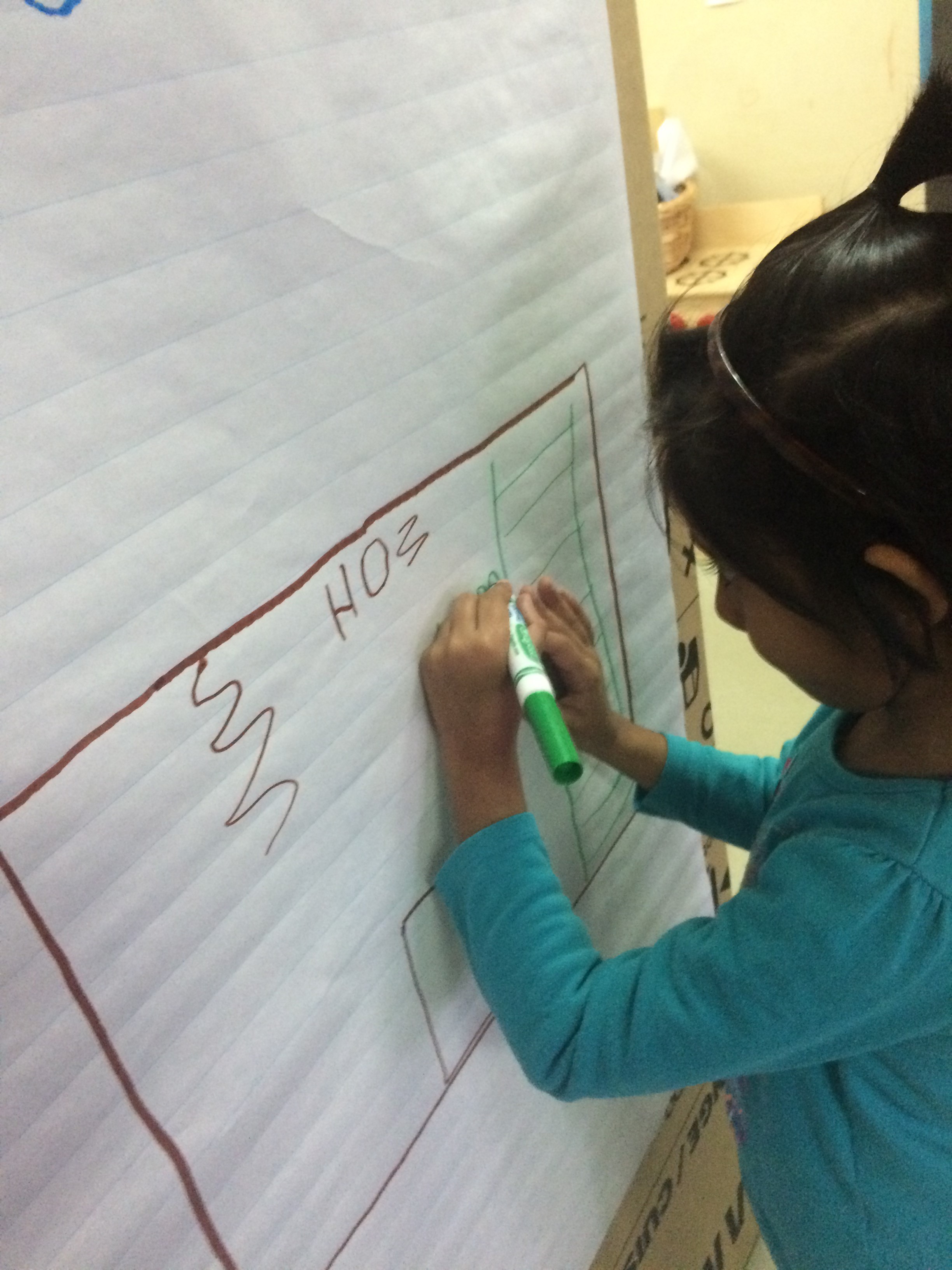
During a large group discussion, Little H contributes an idea to the fire truck plan. Her peers work with her to sound the word “hose” out.
SE1.2. listen and respond to others, both verbally and non-verbally
Little A uses familiar letters and sounds to spell the word “wheel.”
SE 9.1. use reading behaviours to make sense of familiar and unfamiliar texts in print
As the students collaboratively paint the fire truck box, they discuss prior knowledge and experiences with community helpers.
SE 25.3. express their thoughts
As the children take on the role of firefighters, conversation can be over heard as they retell Robert Munsch’s “The Fire Station.”
SE 23.4. communicate their understanding of something (e.g., a familiar story, an experience, a song, a play) by representing their ideas and feelings through the arts


 [
[ [
[

 [All Four Frames: SE 22.1- communicate their ideas about something (e.g., a book, the meaning of a word, an event or an experience, a mathematical pattern, a motion or movement) through music, drama, dance, and/or the visual arts]